A music video is structured by the song first and the story second. Pick a core approach (performance, narrative or concept), cut the track into its sections, give each section a visual job, and let a few images return in every chorus. That is the whole skeleton. The rest of this guide shows how to do each step, with a worked example you can copy for your own track.
TL;DR
- Most music videos use one of three approaches, performance, narrative or concept, and the strongest ones blend them.
- Build the structure from the song's sections: intro, verse, pre-chorus, chorus, bridge, outro. Each gets a clear visual job.
- Visual intensity should rise and fall with musical intensity, and a recurring motif in each chorus ties the picture to the song.
- A three-minute video has little room for dialogue or filler, so show less and let viewers fill the gaps.
- Plan before you shoot or generate: a shot list or storyboard by section saves more money than any editing trick.
Table of Contents
- The three building blocks: performance, narrative, concept
- Start from the song's sections
- Telling a story in three minutes
- Pacing and repetition
- A worked example: a three-minute video, section by section
- Plan before you shoot or generate
- Our perspective: structure is what makes AI video feel directed
- Turn your section map into a finished video
- Checklist: test your structure before you commit
- FAQ
- Sources
The three building blocks: performance, narrative, concept
Before you think about shots, decide what the video is about in structural terms. Media scholars usually sort music videos into a few families, and those families are useful because each one asks for a different skeleton.
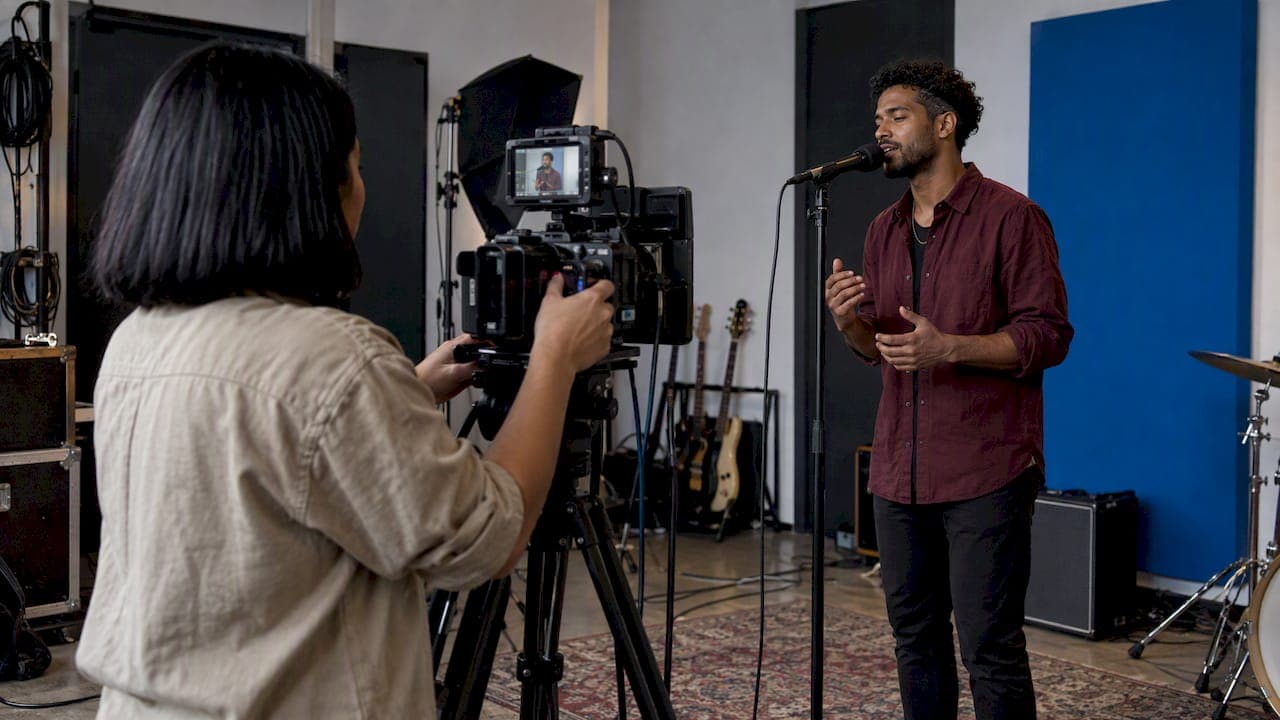
Performance. The artist or band sings to camera or plays on a stage. According to an academic analysis of music-video rhetoric, performance videos present the star or group singing in concert to convey the feeling of the live experience. Structurally, this is the simplest option: the song's sections set the rhythm of your cuts, and variety comes from camera angles, lighting changes and locations.
Narrative. A story with characters, settings and a plot. In narrative videos, characters generally address one another within the story world rather than looking at the audience. Here the structure of the story has to sit on top of the structure of the song, which is the hard part and the subject of most of this article.
Concept. The same academic source describes conceptual videos as relying on poetic form, primarily metaphor, and creating a mood rather than telling a linear story. Think of one striking idea explored in escalating ways: a color, an object, a place, a single repeated action.

Why blending usually wins
Most videos mix styles to engage viewers on different levels, a point made in the genre overview on Media Studies. A practical version: use performance footage as the backbone so the artist is always recognizable, cut in narrative fragments for the verses, and let a conceptual visual carry the chorus. That gives you three tools for solving the one problem every music video has, which is keeping three minutes of the same song visually fresh.
Start from the song's sections
A song has a built-in structure, and your video should respect it. The animation researcher Rosalie Loncin describes aligning picture with music by cutting the song into specific sections like verses and choruses and linking rising musical intensity with visual tension. You can use that approach for live action, animation or AI-generated work alike.
Open your track in any audio editor and mark where each section begins. Then give each one a job:
| Song section | Typical job in the video | Visual approach |
|---|---|---|
| Intro | Set the world and the mood | Wide shots, a single location, slow movement, no full face reveal if you want a payoff later |
| Verse 1 | Introduce the character or the idea | Medium shots, quieter color palette, narrative fragments |
| Pre-chorus | Build tension | Faster cuts, tighter framing, camera moves that push in |
| Chorus | Deliver the signature image | The most striking look, the full performance, the recurring motif |
| Verse 2 | Complicate or develop | Same world, new angle: a second location, a change in the story |
| Bridge | Break the pattern | A different look, a quieter or stranger moment, a reveal |
| Final chorus | Pay off everything | The motif at its biggest, with the change the bridge earned |
| Outro | Resolve | Pull back, slow down, return to the opening image changed |
This table is a starting template, not a law. A track with no bridge simply skips that row. A track that opens on the chorus needs you to show the signature image early and then work out how to top it.
Count in bars, not minutes
Sections are measured in bars, and cuts feel right when they land on bar lines or beats. If you plan by clock time, a tempo change throws everything off. Our guide to planning every cut by bar instead of timecode walks through that method in detail.
Telling a story in three minutes
Narrative music videos work under constraints that a short film does not. The analysis in Storytelling or Telling Stories, a 2025 academic thesis, observes that the shortened form leaves out dialogue and filler moments, so audiences fill in the gaps themselves. That is a gift if you use it well. You do not need to explain how your character got from the kitchen to the rooftop. You need only the three or four images that carry the emotion.
Keep the story to one clear turn
A three-minute story has room for roughly one change: someone loses something, finds something, leaves, returns, realizes something. Give it a beginning state in verse one, pressure in the pre-chorus, a first emotional peak in the chorus, a complication in verse two, a turn in the bridge and a changed state in the final chorus. If you find yourself adding a second subplot, cut it.

Use what you do not show
The same thesis, by Victoria Garrett, discusses disnarration: presenting events that are not shown, that occur out of chronological order, or that exist only in the narrator's mind, which creates tension in music-video stories. In practice, that means you can open on the aftermath, flash back during the bridge, or imply the real event through a single object left in frame. Non-linear storytelling suits music well because songs themselves loop and return.
Make the lyrics and the story work together
Three relationships between lyrics and picture cover most cases:
- Illustration. The picture shows what the words say. It is clear and safe, and often dull if used for the whole song.
- Counterpoint. The picture tells a different story from the words, and the gap creates meaning. A cheerful song over a sad scene is the classic example.
- Expansion. The picture adds context the lyrics only hint at: who the singer is talking to, where they are, what happened before.
Most strong videos switch between these. Illustrate in the hook so viewers connect, counterpoint in the verses for depth.
Pacing and repetition
Pacing should follow the song's progression and rhythm. The animation analysis cited above also points to recurring visual motifs in each chorus that link images to the musical structure. Repetition is not a weakness here. It is how viewers learn the video's visual language, the same way they learn a hook.
A simple pacing method
- Assign a cut rate to each section. For example, long holds in the intro, a moderate rhythm in verses, quicker cuts in the pre-chorus, and a mix of one steady shot and one burst of fast cuts in the chorus.
- Keep one constant. A color, a costume, a location, a prop. It anchors the viewer so the changes read as changes.
- Vary the motif. The chorus image should return each time, but different: wider, closer, brighter, broken, or with a new element. By the final chorus, the viewer should recognize it and feel it has changed.
- Leave a breath. After the loudest chorus, give the eye one calm shot before the next section. Contrast makes the next peak land.
Build the arc like a vocabulary
The band OK Go has described a method of developing a vocabulary of visually interesting moments and then arranging them into an arc that crescendos with the music, as covered in a Project Management Institute piece on how the band makes its videos. You can borrow it at any budget: list twenty small visual ideas first, pick the best eight, and order them from smallest to biggest. The structure comes out of the ranking.
A worked example: a three-minute video, section by section
Here is an invented outline to show the method. Imagine a mid-tempo track about leaving a hometown, with a verse-chorus-verse-chorus-bridge-chorus layout.
- Intro (8 bars). A wide shot of an empty street at dawn. A suitcase sits by a door. No face yet.
- Verse 1. The artist walks through the house, touching objects. Performance to camera, close and quiet. Warm, faded color.
- Pre-chorus. Cuts speed up. Boxes, car keys, a last look in a mirror. The camera pushes in.
- Chorus 1. The artist on the roof at sunrise, singing full voice. Motif: a red scarf in the wind. This is the signature image.
- Verse 2. Same house, now empty. A flashback fragment shows a friend who is not there anymore, an example of disnarration: the story is implied, not explained.
- Chorus 2. The roof again, but at midday, the scarf now tied to the suitcase. The image returns with a change.
- Bridge. Everything goes still. A single shot, no cuts, the artist silent while the music thins out. The look changes to cooler tones.
- Final chorus. The roof at dusk, the scarf released. The biggest, widest version of the motif.
- Outro. The empty street from the intro, now with the door closed. The suitcase is gone.
The story turns once (staying becomes leaving), the performance threads through all of it, and the concept (a red scarf and a roof) holds the chorus together. That is the blend of all three approaches in a single outline.
Plan before you shoot or generate
The step that separates a polished video from a patchy one is the plan. The OK Go case study from the PMI says logistical planning and project management are essential for complex, large-scale music video productions, and that the band puts resources into early creative exploration because they believe early experimentation is what differentiates iconic work. You do not need a crew of fifty to use the lesson: spend your time at the front.
Script, shot list or storyboard?
- A one-page treatment states the idea, the look and the story turn in plain sentences. Write this first.
- A shot list names every shot per section: framing, movement, location, subject. It is the right tool for performance-heavy videos.
- A storyboard draws or describes each frame. It is the right tool for narrative and concept videos, where the order of images carries meaning. Our walkthrough on music video storyboards covers it by bar.
- A script breakdown lists every element a scene needs: props, locations, costumes. If your video has any story, our script breakdown guide shows how to do it.
Mistakes that wreck structure
- Starting with shots instead of sections. A folder of pretty clips with no map to the song leads to an edit that feels random.
- Too many ideas. One concept, one story turn, one motif. Add a second only if the first is finished.
- Same energy throughout. If the verse and the chorus look the same, the song's dynamics vanish.
- Ignoring where it will be watched. If the video is going to live on a vertical feed, plan framing for it from the start, as in our vertical video editing workflow.
Our perspective: structure is what makes AI video feel directed
We built Brix36 around a belief that the hardest part of a music video is not rendering images. It is deciding what each part of the song should look like and making those decisions consistent. When creators come to AI tools without a structure, they get a pile of impressive clips that do not add up. When they come with a section map, a motif and a look, the same tools produce something that feels directed.
That is why section-based storyboarding sits at the center of how we think about production. You work through the song one section at a time, so verses, choruses and bridges each get their own treatment, while the identity of the artist and the look stay consistent from first frame to last. Our one-tap looks exist for the same reason: a single, coherent look across sections is worth more than ten clever shots in ten different styles.
Our advice, whatever tools you use: write the section map first, pick one motif, and decide in advance what changes by the final chorus. Everything else is execution. If you want to see the process end to end, how to make an AI music video from your song lays it out step by step.
— simeon
Turn your section map into a finished video
If you have a track and a structure, you can put them together on Brix36. Our AI lip sync music videos follow your lyrics section by section, and Artist DNA keeps the artist's look consistent across every scene. You pay with credits for what you create rather than a recurring subscription, and you can check how credits work on our credits page.

Starting with a lyric-led piece instead? Our lyric video tutorial covers the order of work, and a finished video can anchor your video portfolio.
Checklist: test your structure before you commit
Run your plan through these questions. If you answer no to any, fix it on paper, where changes are free.
- Can you say the video's idea in one sentence?
- Does every song section have a clear visual job?
- Is there one image that returns in every chorus, and does it change each time?
- Does the bridge break the pattern?
- Does the final chorus pay off something the earlier ones set up?
- Could a viewer follow the story with the sound off?
- Is the artist recognizable in every section?
FAQ
What is the basic structure of a music video?
There is no fixed template, but most videos follow the song: intro, verses, choruses, bridge and outro, each with its own visual treatment. The overall approach is usually performance, narrative, concept or a mix. Start by marking the song's sections, then assign each a job and a look.
How do I write a narrative for a music video?
Keep it to one clear change in three minutes: a state at the start and a different state at the end. Use verses to set up, the pre-chorus to build pressure, the chorus for emotional peaks and the bridge for the turn. Leave out transitions and explanation, because viewers will fill gaps themselves.
Does every music video need a story?
No. Performance videos and conceptual videos work without a linear plot. A conceptual video builds a mood around a metaphor or a repeated image, and a performance video conveys the energy of the live act. Many successful videos combine all three.
How do I keep a music video from getting repetitive?
Vary the cut rate by section, keep one constant element such as a color or a location, and bring the chorus motif back in a new form each time. Add a bridge that breaks the visual pattern, so the final chorus feels earned.
Should I storyboard before making a music video?
Yes, especially for narrative or concept videos where the order of images carries the meaning. A storyboard organized by song section, or by bar, shows gaps and repeated ideas before you spend time or money on production.
Sources
- Cultural Approaches to the Rhetorical Analysis of Selected Music Videos, TRANS Revista Transcultural de Música
- Music Videos and Genre, Media Studies
- Storytelling or Telling Stories: An Analysis of Music Video Narratives, Mississippi State University
- Crystal Clear: From Music to Animation, Animation Studies
- Making Iconic Music Videos: How OK Go Fuses Creativity and Project Management, PMI